


An AI ranking checker tracks how often your brand appears in AI engine responses and in what context. As tools like ChatGPT reshape how buyers discover products, knowing where you stand in those answers is becoming as important as knowing your Google rankings. This post breaks down what to look for in a tracker and why the context of each mention matters just as much as how often you show up.
You've probably opened ChatGPT, searched for something in your category, and watched a competitor get recommended. No obvious reason why them and not you. That moment matters more than it feels like it does.
With AI engines now shaping how buyers discover and shortlist products, your AI visibility is no longer a nice-to-have metric. It's one of the clearest signals of whether your brand is part of the conversation your buyers are already having without you.
This post covers what an AI ranking checker actually does, why tracking it matters right now, and what to look for in a tool. If you're ready to go deeper and build a full tracking system, our AI citation tracking guide covers the complete methodology.
What Is an AI Ranking Checker?
An AI ranking checker is a tool that monitors how AI engines like ChatGPT, Perplexity, and Google AI Overviews reference your brand when answering prompts in your category.
Think of it as a modern take on traditional SEO rank tracking, except instead of measuring your position on a Google results page, it measures your presence inside the answers AI engines give directly to your buyers.
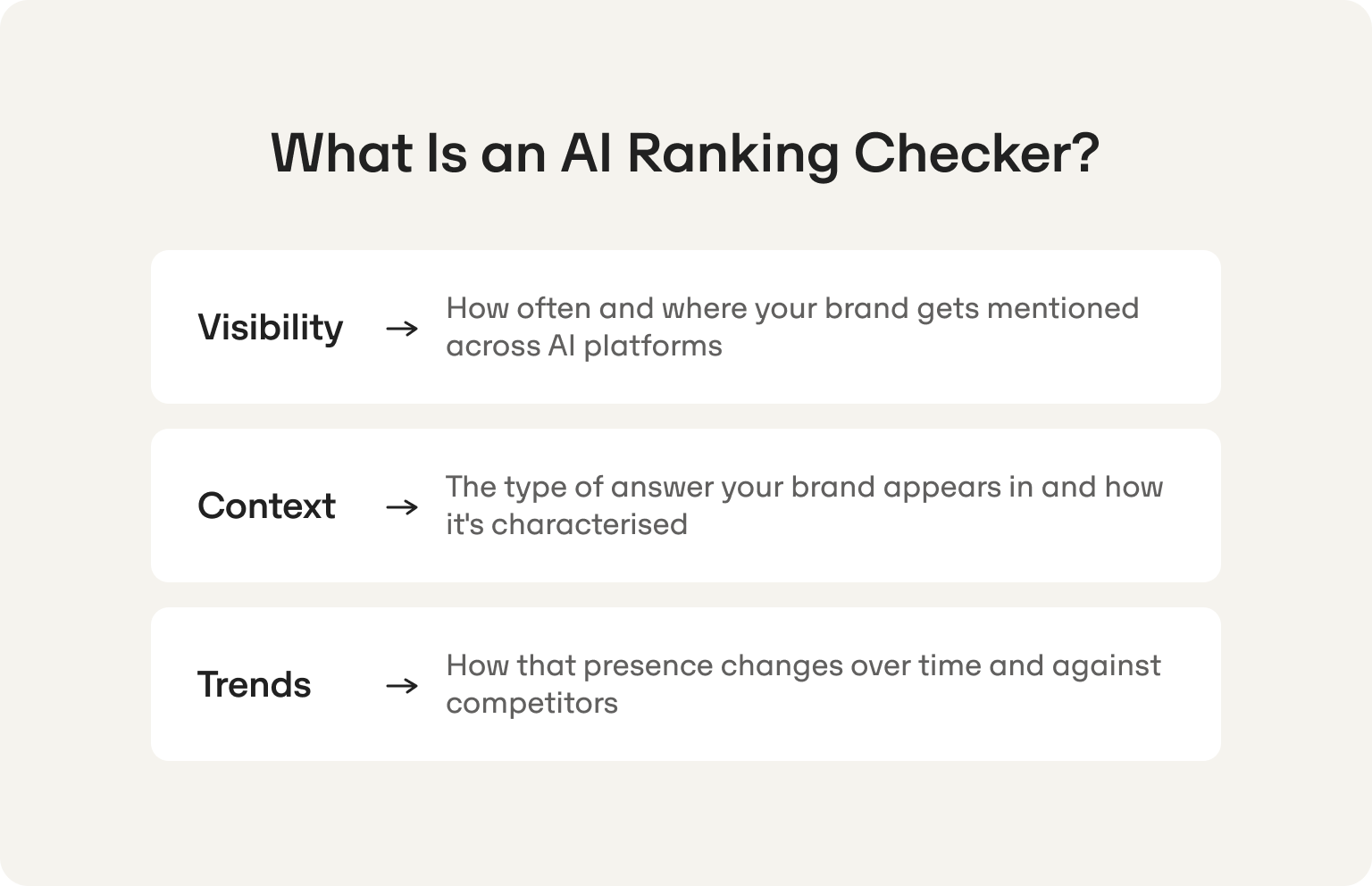
A good tracker helps you understand three things:
- Visibility: how often and where your brand gets mentioned across AI platforms
- Context: the type of answer your brand appears in and how it's characterised
- Trends: how that presence changes over time and against competitors
That last point is worth emphasizing. Volume of mentions matters, but so does context. Being mentioned as "an expensive option for enterprises" and "the best tool for lean startup teams" are very different signals, even if the mention count is identical. This is where AI sentiment analysis becomes relevant: it tells you not just whether you show up, but how you're being characterized when you do.
Why tracking your AI website ranking is important
Buyers are already using AI answers to build shortlists before they ever visit a website. If you're not showing up in those answers, you're losing demand you can't see in your analytics.
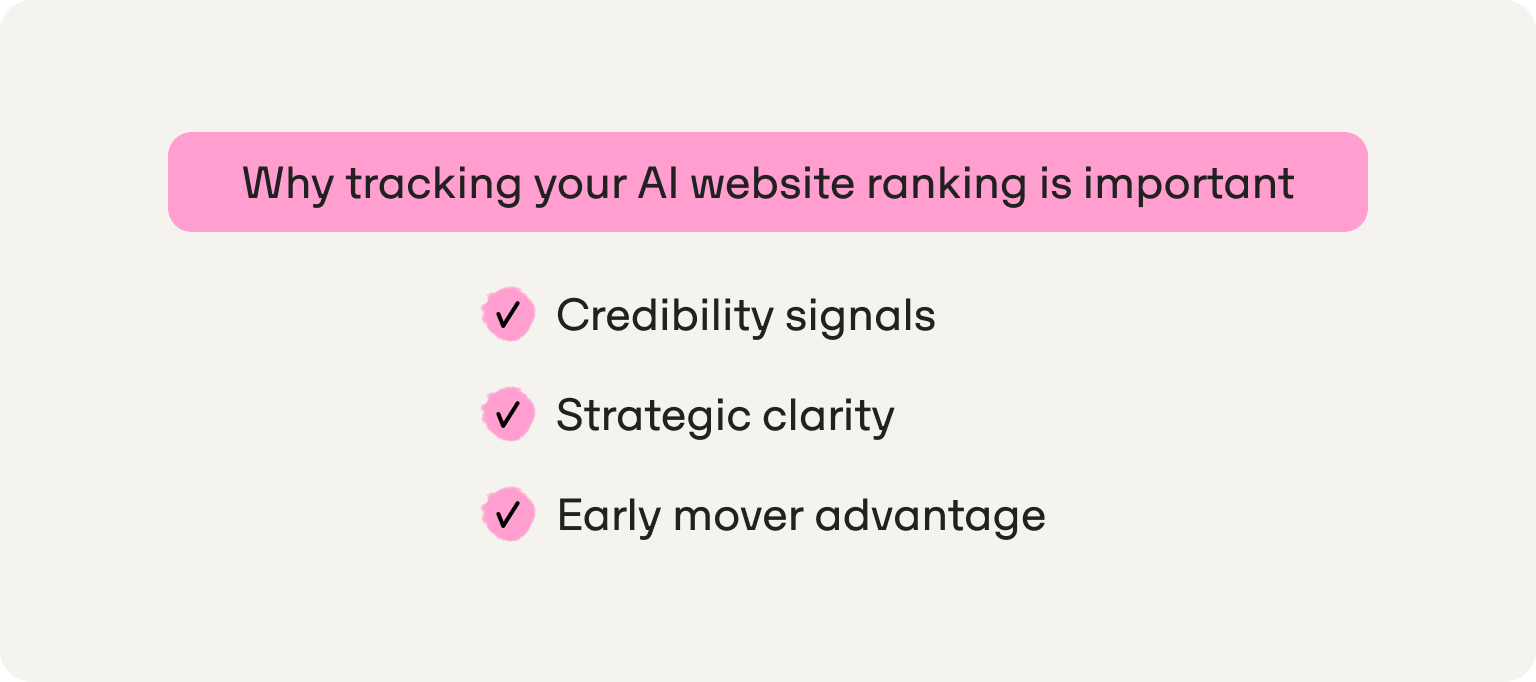
Here's what consistent tracking gives you:
- Credibility signals: regular mentions in AI answers that cite trustworthy sources build authority in ways that compound over time. Understanding source trust signals is part of understanding why some brands consistently appear and others don't.
- Strategic clarity: knowing which prompts and topics trigger mentions of your brand (and your competitors) tells you exactly where to focus your content efforts
- Early mover advantage: most teams are still figuring out generative engine optimization and how it differs from traditional SEO. Getting a baseline now means you have something to act on while competitors are still debating whether it matters
It's also worth understanding the difference between a brand mention and an AI citation. A mention means an AI engine knows your brand exists. A citation means it's actively using your content as a source. Both matter, and they point to different fixes when you're not where you want to be.
Meet Omnia: Your Go-To AI Ranking Checker
Omnia is built for founders and lean marketing teams who want to act on AI visibility data rather than just look at it. It tracks your brand across multiple AI engines, shows which prompts you're winning and losing, and turns that into a concrete list of actions rather than a dashboard to interpret.
A few things worth knowing:
- Comprehensive tracking across ChatGPT, Perplexity, Google AI Overviews, and more
- AI sentiment analysis that shows how your brand is characterised in answers, not just how often it appears
- Competitive share of voice so you can see exactly who is occupying the space you're not
- Actionable outputs over dashboards, because knowing you have a visibility gap is only useful if you know what to do about it
Not ready to commit? The free AI visibility checker generates a report of your current AI presence in a few minutes. No sales call, no setup process. It's a good way to find out whether you have a problem worth solving before going further.
Other AI rank checker tools in the market
Omnia isn't the only option. OtterlyAI and Profound both offer AI visibility tracking and are worth evaluating depending on your needs and budget. The right choice usually comes down to how much you need the insights to connect to execution, and how hands-on your team wants to be with the data.
A few things to keep in mind when using any AI ranking checker
Regardless of which tool you use, a few principles make the difference between tracking that informs decisions and tracking that just produces noise.
Run checks consistently, not just once. AI answers shift by engine, by country, and by prompt wording. A one-off screenshot tells you almost nothing on its own. A weekly cadence across a consistent set of prompts gives you a pattern you can actually act on. This is covered in detail in our guide on how to monitor AI search visibility.
Focus on context, not just count. A tool that tells you "your brand was mentioned 14 times this week" is less useful than one that tells you what those mentions said and which competitors were mentioned alongside you.
Connect what you track to what you publish. The teams that improve their AI visibility fastest are the ones who treat tracking and content as the same workflow, not two separate jobs. If you want to understand how to improve your brand's visibility in ChatGPT specifically, that's a good place to start.
Track share of voice alongside your own mentions. Knowing you appear in 40% of relevant prompts sounds fine until you realise a competitor appears in 80%. Relative presence is what tells you whether you're winning or just showing up.
Start with a baseline
The most useful thing you can do right now is find out where you actually stand. Run a handful of prompts that reflect real buyer intent in your category across two AI engines and note whether your brand appears, in what context, and which competitors keep showing up instead.
That's your baseline. Everything else builds from there. If you want a faster answer, running a free AI visibility report does the same thing in a few minutes and gives you a structured breakdown to work from.